Indian Institute of Creative Skills – (IICS)
Overview
The Indian Institute of Creative Skills (IICS) is where creativity meets opportunity. As a pioneering institution in Media, Entertainment, and creative arts, IICS offers a unique blend of experiential learning, Industry mentorship, and Global exposure to bridge the gap between education and career success.
With state-of-the-art facilities and programs designed by leading Industry experts, IICS equips students with practical skills and entrepreneurial vision to lead in their chosen fields.
The departments of IICS include:
- School of Performing Arts and Media Management
- School of Sound and Music Production
- School of New Age Media
- School of Events and Experiential Media
- School of Creative Communication
- School of Digital Content Creation
Infrastructure and Facilities
- State-of-the-art Production Houses
- Virtual Reality
- Augmented Reality
- International Exposure
- Event Participation
- Industry expert faculty
- Regular sessions with renowned artists and Media professionals
Career Services
- Resume and Portfolio Reviews: Personalized feedback to enhance portfolio of work.
- Job Placement Assistance: Support in arranging Internships and job interviews in Studios and Production companies.
- Freelancing and Entrepreneurship Workshops: Guidance on building a sustainable and successful career in the audio Industry.
India Institute for Future Skills (IIFS)
Overview
Indian Institute for Future Skills (IIFS) are specialised, tech-enabled learning environments designed to prepare learners for high-growth careers in emerging and advanced technologies.
Each centre focuses on a specific technology cluster — from AI and Cloud to Robotics, Cybersecurity, and beyond — with infrastructure, content, and delivery aligned to industry standards. These are not just labs. They are launchpads.
Co-located within academic institutions or standalone facilities, every IIFS operates as an applied learning hub — equipped with advanced tools, global certification, industry-grade simulators, and practitioner-led instruction. Students, professionals, and faculty alike access the latest tools, guided by structured, credit-mapped programs.
IIFS bridges India’s education infrastructure with the technologies that define the global future of work.
Technology Domains Covered
- Artificial Intelligence and Machine Learning
- Data Science
- Cloud Computing and DevOps
- Cybersecurity and Blockchain
- Robotics
- Industrial Automation
- Home Automation
- UI/UX and Design Thinking
- Smart Factory
- Game Design, AR/VR, and Digital Twins
- VFX, Animation, and Media Tech
- App Development
- Semiconductors
- Electronic Vehicle
List of University/Colleges where IIFS Centres are operational
- P.D.A College of Engineering
- DY Patil Agriculture and Technical University
- Srinivas Institute of Technology
- Srinivas University
- Mailam Engineering College
- Sri Manakula Vinayagar Engineering College
- Manakula Vinayagar Institute of Technology
- Lamrin Tech Skills University
- Parul University
- Karnataka State Open University (11 Centres)
About NSDC Insights
Our research delivers actionable skilling insights by assessing global skill landscapes and aligning programs with national policies and SDGs. We map skills, forecast future needs, evaluate initiatives, design community interventions, and collaborate with institutions to shape the future of work and workforce mobility.


Insights Layout
Our Products

Skill Loans
What is a Skill Loan?
A Skill Loan is a financial assistance scheme designed to help individuals fund their vocational or technical training programs.
What is the Model Skill Loan Scheme/ Credit Guarantee Fund Scheme for Skill Development?
Who is eligible for a Skill Loan?/ Am I eligible for a Skill Loan?
Overview
Today ‘Skill Economy’ is market led as new age learning is finding its way in the skill development eco-system. We are witnessing an accelerated fee-based market as youths from urban and semi urban areas are recognizing the availability of skilling and livelihood improvement opportunities. There are ample opportunities for choice of skill courses for any aspiring candidate in sectors such as healthcare, IT, AI-data science, cloud application, digital marketing, hospitality, animation, gaming, graphic designing, drone technology, etc. These are demand led courses for which the fee is paid by the candidate through self-financing or by availing skill-loan. To scale up the market for fee-based advanced level skill courses, there is a need to ensure availability of funding avenues for candidates to undertake such advanced level courses as these courses entail higher course fees. Access to finance is a significant constraint for many aspiring candidates to pay for futuristic and in-demand industry skills courses. Skill Loan Guarantee Scheme (Scheme) anchored by Ministry of Skill Development & Entrepreneurship has been modified in July 2024 to ensure supply of affordable institutional credit to individuals for undertaking skill development courses.
The Modified Skill Loan Guarantee Scheme notified in July 2024 brings significant changes compared to the earlier scheme launched in July 2015. These changes are aimed at expanding the scheme's reach and effectiveness in supporting skill development across India.
Key Modifications in the July 2024 notifications - 2015 Scheme:
- Loan Limit:
- 2015 Scheme: The maximum loan amount was capped at ₹1.5 lakh.
- 2024 Scheme: The loan limit has been increased to ₹7.5 lakh, allowing students to access larger financial support, especially for high-cost courses.
- Eligible Lending Institutions:
- 2015 Scheme: Only banks were eligible lending institutions for providing loans.
- 2024 Scheme: The revised scheme includes non-banking financial companies (NBFCs), micro-finance institutions (MFIs), and small finance banks as eligible lenders, broadening the access points for students.
- Course Coverage:
- 2015 Scheme: Primarily focused on courses aligned with the National Skill Qualifications Framework (NSQF).
- 2024 Scheme: Now includes a wider range of skill development courses, including non-NSQF courses offered by Training Entities on-boarded on Skill India Digital Hub (SIDH), thereby offering more options for students.
- Course Fee:
- 2015 Scheme: Only tuition/course fee was included as an eligible component for loan
- 2024 Scheme: Apart from the regular course fee, the component of skill loan also includes any other reasonable expenditure found necessary for completion of the course including but not limited to assessment fee, examination fee, library charges, laboratory fee, caution deposit, purchase of books, equipment’s and instruments, etc. may also be covered. Also, the cost of boarding and lodging if necessary be considered on merit based on the cost of living in the particular area.
- Credit Guarantee and Accessibility:
- 2015 Scheme: The uptake was low due to stringent credit requirements.
- 2024 Scheme: With enhanced credit guarantees cover, skill loans will be more accessible even to those with weaker credit histories.
- Strategic Focus:
- 2015 Scheme: Focused broadly on supporting skill development.
- 2024 Scheme: Aligns with long-term strategic goals, such as adapting to future technologies and job market changes.
The modified scheme is expected to benefit the skilling eco-system in varied ways:
- Increased Enrollment: Easier access to loans for students will lead to higher enrollment rates for training partners thereby expanding their market reach.
- Reduced Rejections with increased financial Security to lending institutions: The guarantee provided by the scheme reduces the risk for financial institutions, encouraging them to offer loans to even students from economically weaker sections who might not have been able to afford skill development training otherwise.
- Sustainability: The increased and steady flow of students and funds will help skilling institutions sustain and grow their operations, contributing to the overall success of the skill development ecosystem in India.
These modifications are expected to make the scheme more impactful by addressing the limitations of the previous version, especially in terms of financial accessibility and the variety of courses covered.
Faq's
Access to finance is a significant constraint for aspiring candidates to pay for futuristic and in-demand industry skills courses. Under the Skill Loan initiative, NSDC gave a line of credit to NBFCs/Micro Finance Institutions at concessional rates to pass on the benefit of subsidised lending to candidates in the form of affordable interest rates. The Skill Loan Guarantee Scheme anchored by Ministry of Skill Development & Entrepreneurship enables aspiring candidates to avail collateral free skill loans for undertaking advanced level in-demand skill courses having good placement potential.

Access to finance is a significant constraint for aspiring candidates to pay for futuristic and in-demand industry skills courses. Under the Skill Loan initiative, NSDC gave a line of credit to NBFCs/Micro Finance Institutions at concessional rates to pass on the benefit of subsidised lending to candidates in the form of affordable interest rates. The Skill Loan Guarantee Scheme anchored by Ministry of Skill Development & Entrepreneurship enables aspiring candidates to avail collateral free skill loans for undertaking advanced level in-demand skill courses having good placement potential.
Skill Impact Bond
Impact Created
Beneficiary profile (https://nsdcindia.org/sib)
Total enrolment: 34460+ (until 31st Jan,2025)
Women enrolment: 74%
Sectors covered: 14
States covered: 18
Cohort performance (to be retained from current webpage)
Consortium of Partners (to be retained from current webpage)
Partner bytes: (to be retained from current webpage)
1. Student case studies (to be retained from current webpage)
2. Hear from our trainee video (to be retained from current webpage)
3. Media Highlights (to be retained from current webpage)
India’s first Skill Impact Bond for sustained employment of youth
Sharing the vision of making young Indians ready for employment, the Skill Impact Bond is the first development impact bond in India dedicated to skills training and job placement. The 130 Cr fund has been set up to benefit 50,000 young Indians over four years, with 60% of the beneficiaries being women. This innovative outcomes-based financing tool uses private sector capital and expertise, focusing on job placement and retention rather than merely on training and certification.
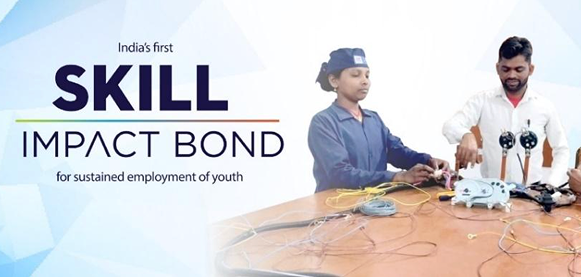
The Skill Impact Bond links funding to achievement of outcomes, inverting the process of conventional grant-making which often funds activities and inputs. The initial financing to training providers is supported by risk investors, who are repaid by outcome funders on the achievement of predetermined, independently verified outcomes achieved by training partners.
This results in maximum impact for money spent, aligned incentives between partners, thus creating measurable social impact that spur social change
Access to finance is a significant constraint for aspiring candidates to pay for futuristic and in-demand industry skills courses. Under the Skill Loan initiative, NSDC gave a line of credit to NBFCs/Micro Finance Institutions at concessional rates to pass on the benefit of subsidised lending to candidates in the form of affordable interest rates. The Skill Loan Guarantee Scheme anchored by Ministry of Skill Development & Entrepreneurship enables aspiring candidates to avail collateral free skill loans for undertaking advanced level in-demand skill courses having good placement potential.

Corporate Social Responsibility (CSR)
Overview
NSDC’s CSR programs are structured around NSDC’s core values:
- Impact: NSDC’s CSR programs are committed to delivering measurable, scalable, and sustainable socio-economic impact. By aligning with national development priorities and local community needs, CSR programs are designed to enhance livelihoods, build resilience, and drive long-term transformation in the lives of target groups.
- Integrity: Guided by principles of ethical governance, transparency, and accountability, NSDC’s CSR programs operates with the highest standards of integrity. Collaborative efforts are built on trust and responsibility, ensuring that all interventions uphold dignity, respect, and social justice.
- Inclusion: NSDC’s CSR programs are driven by a strong commitment to equity. The programmes actively prioritize vulnerable and marginalized groups including women, transgender, especially abled and socio-economically marginalized communities and minorities ensuring access to skilling & entrepreneurship opportunities for livelihood generation.
- Innovation: NSDC’s CSR programme fosters a culture of innovation by leveraging technology, social enterprise models. Programs are designed to be agile, context-responsive, and future-ready, empowering communities to thrive in a rapidly evolving socio-economic landscape.
NSDC's Models for CSR Programs
The CSR division of NSDC aims to co-create transformative flagship programs that advance entrepreneurship and skill development as pathways to socio-economic empowerment. With a strong focus on improving quality of life, resilience and income generation, these initiatives prioritize vulnerable groups and marginalized communities ensuring equitable access to opportunities and resources amongst them.

Sponsorship of Candidates for Skill Development
- Contribute funds directly to the National Skill Development Fund (NSDF) or National Skill Development Corporation (NSDC) to meet and fulfil CSR commitments under the Companies (Corporate Social Responsibility) Act, 2013.
- Sponsor candidates for skilling programs in priority areas/sectors (programs focused on livelihoods, persons with disabilities, special areas, etc.) in geographical area as suggested by company
- Operationalize Project through agreement amongst Company, NSDF and NSDC.
- Offer existing facilities and machinery for on-the-job training where available.
- Implement the project through NSDC Training Partners with project management support by NSDC at nominal cost (as per Common Norms Gazette Notification)
Setting up of Multi Skill Center
- Setup/upgrade a skill development facility to be multi skill centre focused in sector/areas of strategic importance.
- The Multi Skill Center to be of a state-of-the-art aspirational centre with highly advanced skill equipment with support from sector relevant industry, for promoting higher level of skilling in the country.
- Set up corporate owned multi-sectoral skill training centres/institutes.
- The centre may be operated directly by the Corporate or through NSDC affiliated implementation Partner as per standards aligned to the NSQF/ Non-NSQF courses.
- Focus on Training of Trainer (ToT), Training of Assessor (ToA) programs, specialized programs focused on high skilled trades, etc.
- Establish collaboration with foreign partners to develop transnational standards through G2G/B2B partnerships with the support of NSDC.
- Co-brand centre/institute with Skill India.
Support Trade-Specific Labs/Centers
- Corporate can setup/ donate labs/ centres to support skill development programs addressing industry need for skilled manpower at trade-level.
- Corporate and NSDC can jointly identify training centres to upgrade/augment labs in such centres.
- Corporate can jointly monitor with NSDC to make certain such centres are delivering as per plan and on quality standards set forth.
- Ensure continuous engagement through technology and knowledge interventions, on-the-job training/apprenticeship programs for graduates, etc.
- Government schemes (like PMKVY) may be converged in such centres where focus is on underprivileged youth, to offset the cost of training and assessment.
Right to use Land, Building, Machinery
- Provide right of usage to an appropriate facility to be used as a skill development centre.
- Support existing programs through basic setup costs and equipment donation to offset training programs that are cost intensive.
- Provision land usage for specific programs like Driver Training Centres, Construction-related trades, etc. with high employment potential.
- Operationalize through an NSDC affiliated Training Partner.
- Combine with sponsorship of candidates’ trainings.
Skill Advisory
- NSDC to act as the Knowledge Partner and Industry as the Infrastructure Partner and/ or Implementation Partner to establish multi skill centres or operationalize already existing centres.
- The combination of technical knowhow of Skills along with sector expertise assuring a highly aspirational centre with supreme training quality.
- The model necessitates active involvement of the Sector Skill Councils, ensuring alignment of sectoral requirements and expectations.
- The multi skill centres may be implemented in two ways as deemed feasible by the Funding Organization:
- The Funding Organization provide funds to NSDC for both Infrastructure or setting up the Training Centre/ multi skill centres and operationalizing the skill training project.
- The Funding Organization will set up the Infrastructure or the Training Centre/ multi skill centres and will provide funds to NSDC for Skill Advisory where NSDC will facilitate operationalization the skill training project.
- Participate in various activities of one or more relevant Sector Skill Councils in line with your business operations.
- Work directly with Sector Skill Councils to contribute to development of industry standards for skill development under the NSQF.
- Provide list of persons (including retirees) to be (master) trainers and assessors where feasible.
Supporting Apprenticeship through CSR
- Utilization of CSR funds for Apprenticeship training under ‘Skill training’ already covered under item no. (ii) of Schedule VII of the Companies Act.)
- CSR funds for Apprenticeship training to include expenditure on Basic Training and stipend payable to apprentices under Apprentices Act 1961.
- Expenditure on Apprenticeship training over & above of 2.5% i.e., minimum mandate as per Apprentices Act, can be utilized under CSR funding.
Setup A Skill Development Organization /Business Unit
- Setup a Skill Development Organization either as a new business unit, independent trust/society or a newly incorporated special purpose vehicle with equity infusion from parent entity and/or promoters/trustees.
- Access funding from NSDC on subsidized terms
- Become a Non-Funding Training Partner where funding is not sought.
Entrepreneurship and Livelihood Promotion
- Skill development and training for entrepreneurs
- Facilitate business planning and market linkages
- Build long term resilience
The CSR division of NSDC aims to co-create transformative flagship programs that advance entrepreneurship and skill development as pathways to socio-economic empowerment. With a strong focus on improving quality of life, resilience and income generation, these initiatives prioritize vulnerable groups and marginalized communities ensuring equitable access to opportunities and resources amongst them.
Blended Finance
Risk Guarantee Structure
Risk Guarantee structure is tool that can enable lending institutions to pump in sizeable commercial capital to augment the lending portfolio in skilling ecosystem. Under this model of financing, NSDC provides risk guarantee to lending institutions to deploy commercial capital for onward lending in the form of skill loans to aspiring candidates pursing in-demand market led skill courses. Risk of default for such lending in borne by the risk guarantee provided by NSDC.
Alternatively, donor capital is taken as guarantee by NSDC to provide concessional capital for outcome based social projects to finance working capital / project finance needs of implementing organizations / service providers. The guarantee structure boosts supply of institutional credit for development projects and significantly scales up the beneficiaries especially from economically weaker sections of the community. Upon successful outcome of the project, the repayment of working capital / project finance loans is done by the outcome funder / grant provider. The risk of under-performance is subsumed by the guarantee provider and implementing organization.
Outcome Based Financing
Under this structure, NSDC along with other impact investors provides risk capital upfront to fund the service provider for pre-determined social interventions. The service provider delivers the interventions to achieve pre-determined outcomes. The outcome is verified by an independent third-party evaluator. The under-performance of the project, if any, is borne by NSDC as risk investor. However, upon successful outcomes, the risk investors get repaid by outcome funders. The result is maximum impact as capital commitment by risk investors is responsibly deployed, service provider’s performance is outcome oriented as its payout is linked to its performance and outcome funder can replace traditional grant model by paying only if project delivers predetermined outcome of the project.
Impact capital from government and impact investors is deployed for outcome-based skilling programs
Social Stock Exchange
Social Stock Exchange functions as a unique fund-raising platform for Social Enterprises to mobilize funds for Skill Development Projects / Programs through private placement or public issue of its instruments listed on SSE.
SSEs will make use of mature financial and capital markets to channelize and leverage resources towards social causes whose impact will be measurable. Social Enterprises can choose from a variety of instruments such as Zero Coupon Zero Principal Bonds, Development Impact Bonds, Social Impact Bonds, etc for issuance and listing on SSE. SEBI has notified ZCZP as eligible security for registration on Social Stock Exchange. These are issued for raising funds for a particular project. The outcome of the project will be evaluated by the social auditor.
NSDC is now registered with SSE Platform of both National Stock Exchange, Bombay Stock Exchange and is eligible to raise funds on its SSE platform. It will soon be listing an instrument on SSE for specific Skilling Projects.
Blended Finance functions as a unique fund-raising platform for Social Enterprises to mobilize funds for Skill Development Projects / Programs through private placement or public issue of its instruments listed on SSE.

Access to finance is a significant constraint for aspiring candidates to pay for futuristic and in-demand industry skills courses. Under the Skill Loan initiative, NSDC gave a line of credit to NBFCs/Micro Finance Institutions at concessional rates to pass on the benefit of subsidised lending to candidates in the form of affordable interest rates. The Skill Loan Guarantee Scheme anchored by Ministry of Skill Development & Entrepreneurship enables aspiring candidates to avail collateral free skill loans for undertaking advanced level in-demand skill courses having good placement potential.

Funding partnerships and Monitoring
NSDC Funded Affiliation - Overview
NSDC Funded Affiliation - Overview
- We aim to catalyse the creation of sustainable and quality skills training institutions across the country.
- Our mission includes supporting and coordinating private sector initiatives for skill development through appropriate Public Private Partnership models. We strive for significant operational and financial involvement from the private sector.
- We play the role of a ‘market maker’ by bring financing to sectors where mechanisms are weak or missing.
- Our focus is on prioritising initiatives that can have multiplier or catalytic effect on the capacity and quality of skilling in India.

Blended Finance functions as a unique fund-raising platform for Social Enterprises to mobilize funds for Skill Development Projects / Programs through private placement or public issue of its instruments listed on SSE.
Quality Assurance
Overview
Our comprehensive quality assurance framework spans the entire skill development ecosystem, driving measurable improvements through evidence-based approaches. The Quality Assurance serves as the cornerstone of excellence within the National Skill Development ecosystem, implementing a comprehensive framework that ensures all programs meet rigorous quality standards.
Our division integrates specialized sub-divisions: Standards, Accreditation and Affiliation, and Monitoring Evaluation & Learning to create a holistic quality management system. Through our Standards sub-division, we facilitate collaboration between government, academia, and industry to develop and implement NSQF-aligned competency frameworks that serve as the foundation for quality training delivery. These standards establish a common skills language that enhances labour market efficiency and ensures training relevance.
Our quality assurance interventions drive measurable improvements in training outcomes by implementing evidence-based approaches to program design, delivery, and evaluation. We maintain a balance between compliance and innovation, establishing clear benchmarks while encouraging continuous improvement and adaptation to emerging industry needs.
A comprehensive quality management system that covers the entire training lifecycle from standards development to outcome assessment
Multi-layered monitoring and verification systems that ensure integrity and compliance throughout program implementation
Continuous collaboration with industry leaders ensures training standards remain relevant to current and emerging workplace requirements
Advanced analytics provide actionable intelligence for continuous improvement and evidence-based decision making
Consistent assessment criteria ensure fair and reliable evaluation of training centers, trainers, and learning outcomes
International harmonization efforts ensure Indian skill standards align with global best practices and industry requirements
Our comprehensive quality assurance framework spans the entire skill development ecosystem, driving measurable improvements through evidence-based approaches. The Quality Assurance serves as the cornerstone of excellence within the National Skill Development ecosystem, implementing a comprehensive framework that ensures all programs meet rigorous quality standards.
Skill Impact Bond
Impact Created
Beneficiary profile (https://nsdcindia.org/sib)
Total enrolment: 34460+ (until 31st Jan,2025)
Women enrolment: 74%
Sectors covered: 14
States covered: 18
Cohort performance (to be retained from current webpage)
Consortium of Partners (to be retained from current webpage)
Partner bytes: (to be retained from current webpage)
1. Student case studies (to be retained from current webpage)
2. Hear from our trainee video (to be retained from current webpage)
3. Media Highlights (to be retained from current webpage)
India’s first Skill Impact Bond for sustained employment of youth
Sharing the vision of making young Indians ready for employment, the Skill Impact Bond is the first development impact bond in India dedicated to skills training and job placement. The 130 Cr fund has been set up to benefit 50,000 young Indians over four years, with 60% of the beneficiaries being women. This innovative outcomes-based financing tool uses private sector capital and expertise, focusing on job placement and retention rather than merely on training and certification.
The Skill Impact Bond links funding to achievement of outcomes, inverting the process of conventional grant-making which often funds activities and inputs. The initial financing to training providers is supported by risk investors, who are repaid by outcome funders on the achievement of predetermined, independently verified outcomes achieved by training partners.
This results in maximum impact for money spent, aligned incentives between partners, thus creating measurable social impact that spur social change
Corporate Social Responsibility (CSR)
Overview
NSDC’s CSR programs are structured around NSDC’s core values:
- Impact: NSDC’s CSR programs are committed to delivering measurable, scalable, and sustainable socio-economic impact. By aligning with national development priorities and local community needs, CSR programs are designed to enhance livelihoods, build resilience, and drive long-term transformation in the lives of target groups.
- Integrity: Guided by principles of ethical governance, transparency, and accountability, NSDC’s CSR programs operates with the highest standards of integrity. Collaborative efforts are built on trust and responsibility, ensuring that all interventions uphold dignity, respect, and social justice.
- Inclusion: NSDC’s CSR programs are driven by a strong commitment to equity. The programmes actively prioritize vulnerable and marginalized groups including women, transgender, especially abled and socio-economically marginalized communities and minorities ensuring access to skilling & entrepreneurship opportunities for livelihood generation.
- Innovation: NSDC’s CSR programme fosters a culture of innovation by leveraging technology, social enterprise models. Programs are designed to be agile, context-responsive, and future-ready, empowering communities to thrive in a rapidly evolving socio-economic landscape.
NSDC's Models for CSR Programs
The CSR division of NSDC aims to co-create transformative flagship programs that advance entrepreneurship and skill development as pathways to socio-economic empowerment. With a strong focus on improving quality of life, resilience and income generation, these initiatives prioritize vulnerable groups and marginalized communities ensuring equitable access to opportunities and resources amongst them.
Sponsorship of Candidates for Skill Development
- Contribute funds directly to the National Skill Development Fund (NSDF) or National Skill Development Corporation (NSDC) to meet and fulfil CSR commitments under the Companies (Corporate Social Responsibility) Act, 2013.
- Sponsor candidates for skilling programs in priority areas/sectors (programs focused on livelihoods, persons with disabilities, special areas, etc.) in geographical area as suggested by company
- Operationalize Project through agreement amongst Company, NSDF and NSDC.
- Offer existing facilities and machinery for on-the-job training where available.
- Implement the project through NSDC Training Partners with project management support by NSDC at nominal cost (as per Common Norms Gazette Notification)
Setting up of Multi Skill Center
- Setup/upgrade a skill development facility to be multi skill centre focused in sector/areas of strategic importance.
- The Multi Skill Center to be of a state-of-the-art aspirational centre with highly advanced skill equipment with support from sector relevant industry, for promoting higher level of skilling in the country.
- Set up corporate owned multi-sectoral skill training centres/institutes.
- The centre may be operated directly by the Corporate or through NSDC affiliated implementation Partner as per standards aligned to the NSQF/ Non-NSQF courses.
- Focus on Training of Trainer (ToT), Training of Assessor (ToA) programs, specialized programs focused on high skilled trades, etc.
- Establish collaboration with foreign partners to develop transnational standards through G2G/B2B partnerships with the support of NSDC.
- Co-brand centre/institute with Skill India.
Support Trade-Specific Labs/Centers
- Corporate can setup/ donate labs/ centres to support skill development programs addressing industry need for skilled manpower at trade-level.
- Corporate and NSDC can jointly identify training centres to upgrade/augment labs in such centres.
- Corporate can jointly monitor with NSDC to make certain such centres are delivering as per plan and on quality standards set forth.
- Ensure continuous engagement through technology and knowledge interventions, on-the-job training/apprenticeship programs for graduates, etc.
- Government schemes (like PMKVY) may be converged in such centres where focus is on underprivileged youth, to offset the cost of training and assessment.
Right to use Land, Building, Machinery
- Provide right of usage to an appropriate facility to be used as a skill development centre.
- Support existing programs through basic setup costs and equipment donation to offset training programs that are cost intensive.
- Provision land usage for specific programs like Driver Training Centres, Construction-related trades, etc. with high employment potential.
- Operationalize through an NSDC affiliated Training Partner.
- Combine with sponsorship of candidates’ trainings.
Skill Advisory
- NSDC to act as the Knowledge Partner and Industry as the Infrastructure Partner and/ or Implementation Partner to establish multi skill centres or operationalize already existing centres.
- The combination of technical knowhow of Skills along with sector expertise assuring a highly aspirational centre with supreme training quality.
- The model necessitates active involvement of the Sector Skill Councils, ensuring alignment of sectoral requirements and expectations.
- The multi skill centres may be implemented in two ways as deemed feasible by the Funding Organization:
- The Funding Organization provide funds to NSDC for both Infrastructure or setting up the Training Centre/ multi skill centres and operationalizing the skill training project.
- The Funding Organization will set up the Infrastructure or the Training Centre/ multi skill centres and will provide funds to NSDC for Skill Advisory where NSDC will facilitate operationalization the skill training project.
- Participate in various activities of one or more relevant Sector Skill Councils in line with your business operations.
- Work directly with Sector Skill Councils to contribute to development of industry standards for skill development under the NSQF.
- Provide list of persons (including retirees) to be (master) trainers and assessors where feasible.
Supporting Apprenticeship through CSR
- Utilization of CSR funds for Apprenticeship training under ‘Skill training’ already covered under item no. (ii) of Schedule VII of the Companies Act.)
- CSR funds for Apprenticeship training to include expenditure on Basic Training and stipend payable to apprentices under Apprentices Act 1961.
- Expenditure on Apprenticeship training over & above of 2.5% i.e., minimum mandate as per Apprentices Act, can be utilized under CSR funding.
Setup A Skill Development Organization /Business Unit
- Setup a Skill Development Organization either as a new business unit, independent trust/society or a newly incorporated special purpose vehicle with equity infusion from parent entity and/or promoters/trustees.
- Access funding from NSDC on subsidized terms
- Become a Non-Funding Training Partner where funding is not sought.
Entrepreneurship and Livelihood Promotion
- Skill development and training for entrepreneurs
- Facilitate business planning and market linkages
- Build long term resilience
Blended Finance
Risk Guarantee Structure
Risk Guarantee structure is tool that can enable lending institutions to pump in sizeable commercial capital to augment the lending portfolio in skilling ecosystem. Under this model of financing, NSDC provides risk guarantee to lending institutions to deploy commercial capital for onward lending in the form of skill loans to aspiring candidates pursing in-demand market led skill courses. Risk of default for such lending in borne by the risk guarantee provided by NSDC.
Alternatively, donor capital is taken as guarantee by NSDC to provide concessional capital for outcome based social projects to finance working capital / project finance needs of implementing organizations / service providers. The guarantee structure boosts supply of institutional credit for development projects and significantly scales up the beneficiaries especially from economically weaker sections of the community. Upon successful outcome of the project, the repayment of working capital / project finance loans is done by the outcome funder / grant provider. The risk of under-performance is subsumed by the guarantee provider and implementing organization.
Outcome Based Financing
Under this structure, NSDC along with other impact investors provides risk capital upfront to fund the service provider for pre-determined social interventions. The service provider delivers the interventions to achieve pre-determined outcomes. The outcome is verified by an independent third-party evaluator. The under-performance of the project, if any, is borne by NSDC as risk investor. However, upon successful outcomes, the risk investors get repaid by outcome funders. The result is maximum impact as capital commitment by risk investors is responsibly deployed, service provider’s performance is outcome oriented as its payout is linked to its performance and outcome funder can replace traditional grant model by paying only if project delivers predetermined outcome of the project.
Impact capital from government and impact investors is deployed for outcome-based skilling programs
Social Stock Exchange
Social Stock Exchange functions as a unique fund-raising platform for Social Enterprises to mobilize funds for Skill Development Projects / Programs through private placement or public issue of its instruments listed on SSE.
SSEs will make use of mature financial and capital markets to channelize and leverage resources towards social causes whose impact will be measurable. Social Enterprises can choose from a variety of instruments such as Zero Coupon Zero Principal Bonds, Development Impact Bonds, Social Impact Bonds, etc for issuance and listing on SSE. SEBI has notified ZCZP as eligible security for registration on Social Stock Exchange. These are issued for raising funds for a particular project. The outcome of the project will be evaluated by the social auditor.
NSDC is now registered with SSE Platform of both National Stock Exchange, Bombay Stock Exchange and is eligible to raise funds on its SSE platform. It will soon be listing an instrument on SSE for specific Skilling Projects.
Blended Finance functions as a unique fund-raising platform for Social Enterprises to mobilize funds for Skill Development Projects / Programs through private placement or public issue of its instruments listed on SSE.
Funding partnerships and Monitoring
NSDC Funded Affiliation - Overview
NSDC Funded Affiliation - Overview
- We aim to catalyse the creation of sustainable and quality skills training institutions across the country.
- Our mission includes supporting and coordinating private sector initiatives for skill development through appropriate Public Private Partnership models. We strive for significant operational and financial involvement from the private sector.
- We play the role of a ‘market maker’ by bring financing to sectors where mechanisms are weak or missing.
- Our focus is on prioritising initiatives that can have multiplier or catalytic effect on the capacity and quality of skilling in India.
Skill Loans
What is a Skill Loan?
A Skill Loan is a financial assistance scheme designed to help individuals fund their vocational or technical training programs.
What is the Model Skill Loan Scheme/ Credit Guarantee Fund Scheme for Skill Development?
Who is eligible for a Skill Loan?/ Am I eligible for a Skill Loan?
Overview
Today ‘Skill Economy’ is market led as new age learning is finding its way in the skill development eco-system. We are witnessing an accelerated fee-based market as youths from urban and semi urban areas are recognizing the availability of skilling and livelihood improvement opportunities. There are ample opportunities for choice of skill courses for any aspiring candidate in sectors such as healthcare, IT, AI-data science, cloud application, digital marketing, hospitality, animation, gaming, graphic designing, drone technology, etc. These are demand led courses for which the fee is paid by the candidate through self-financing or by availing skill-loan. To scale up the market for fee-based advanced level skill courses, there is a need to ensure availability of funding avenues for candidates to undertake such advanced level courses as these courses entail higher course fees. Access to finance is a significant constraint for many aspiring candidates to pay for futuristic and in-demand industry skills courses. Skill Loan Guarantee Scheme (Scheme) anchored by Ministry of Skill Development & Entrepreneurship has been modified in July 2024 to ensure supply of affordable institutional credit to individuals for undertaking skill development courses.
The Modified Skill Loan Guarantee Scheme notified in July 2024 brings significant changes compared to the earlier scheme launched in July 2015. These changes are aimed at expanding the scheme's reach and effectiveness in supporting skill development across India.
Key Modifications in the July 2024 notifications - 2015 Scheme:
- Loan Limit:
- 2015 Scheme: The maximum loan amount was capped at ₹1.5 lakh.
- 2024 Scheme: The loan limit has been increased to ₹7.5 lakh, allowing students to access larger financial support, especially for high-cost courses.
- Eligible Lending Institutions:
- 2015 Scheme: Only banks were eligible lending institutions for providing loans.
- 2024 Scheme: The revised scheme includes non-banking financial companies (NBFCs), micro-finance institutions (MFIs), and small finance banks as eligible lenders, broadening the access points for students.
- Course Coverage:
- 2015 Scheme: Primarily focused on courses aligned with the National Skill Qualifications Framework (NSQF).
- 2024 Scheme: Now includes a wider range of skill development courses, including non-NSQF courses offered by Training Entities on-boarded on Skill India Digital Hub (SIDH), thereby offering more options for students.
- Course Fee:
- 2015 Scheme: Only tuition/course fee was included as an eligible component for loan
- 2024 Scheme: Apart from the regular course fee, the component of skill loan also includes any other reasonable expenditure found necessary for completion of the course including but not limited to assessment fee, examination fee, library charges, laboratory fee, caution deposit, purchase of books, equipment’s and instruments, etc. may also be covered. Also, the cost of boarding and lodging if necessary be considered on merit based on the cost of living in the particular area.
- Credit Guarantee and Accessibility:
- 2015 Scheme: The uptake was low due to stringent credit requirements.
- 2024 Scheme: With enhanced credit guarantees cover, skill loans will be more accessible even to those with weaker credit histories.
- Strategic Focus:
- 2015 Scheme: Focused broadly on supporting skill development.
- 2024 Scheme: Aligns with long-term strategic goals, such as adapting to future technologies and job market changes.
The modified scheme is expected to benefit the skilling eco-system in varied ways:
- Increased Enrollment: Easier access to loans for students will lead to higher enrollment rates for training partners thereby expanding their market reach.
- Reduced Rejections with increased financial Security to lending institutions: The guarantee provided by the scheme reduces the risk for financial institutions, encouraging them to offer loans to even students from economically weaker sections who might not have been able to afford skill development training otherwise.
- Sustainability: The increased and steady flow of students and funds will help skilling institutions sustain and grow their operations, contributing to the overall success of the skill development ecosystem in India.
These modifications are expected to make the scheme more impactful by addressing the limitations of the previous version, especially in terms of financial accessibility and the variety of courses covered.
Faq's
Access to finance is a significant constraint for aspiring candidates to pay for futuristic and in-demand industry skills courses. Under the Skill Loan initiative, NSDC gave a line of credit to NBFCs/Micro Finance Institutions at concessional rates to pass on the benefit of subsidised lending to candidates in the form of affordable interest rates. The Skill Loan Guarantee Scheme anchored by Ministry of Skill Development & Entrepreneurship enables aspiring candidates to avail collateral free skill loans for undertaking advanced level in-demand skill courses having good placement potential.